


Workshop Recap: Recent Advances and Challenges in Safe Sport Entities
On March 23rd, the Athletes Network for Safer Sports held an online workshop exploring the development of ‘safe sport entities’ – organizations designed to address harassment and abuse in sport.
Featuring Alison Quigley, survivor of abuse in gymnastics, safe sport advocate, researcher and founder of Athlete Rights Australia; sport lawyer and ethicist Guilherme Campos de Moraes; and Network Coordinator Joanna Maranhão, the discussion centered on recent advances and challenges identified by survivors and advocates when developing and reforming safe sport entities.
The session opened with an overview of safe sport entities, including both national and sport-specific bodies. While some initiatives are mandated exclusively to handle safe sport issues, others incorporate safeguarding within broader integrity agencies that oversee a range of issues such as anti-doping, match-fixing, corruption, and other topics.
While there can be intersections between certain integrity issues – for example, doping concerns that overlap with safeguarding, particularly when minors are involved – each topic requires specific expertise. For harassment and abuse in sport in particular, it is widely recognized that the long-lasting impacts of trauma contribute an added layer of complexity that demands careful, informed handling.
“There’s no one-size-fits-all model or strategy. It depends on the context – but we need to copy the principles of non-retaliation, independence and trauma-informed approach.”
When asked about the best way to structure safe sport entities, Guilherme emphasized that independence within integrity systems is never absolute. He noted that integrity management rests on four pillars, each requiring trade‑offs and morally-responsible leadership. Joanna added that independence cannot mean isolation or lack of mandate — entities must remain connected to broader safeguarding structures, including clear risk assessments for major sporting events.
In Guilherme’s view, the ideal structure is the one that maximizes independence, autonomy and transparency. Expanding on the importance of independence and transparency, he emphasized that interference from other bodies or government actors or lack of clear communication around prohibited behaviors could undermine the effectiveness of safe sport initiatives.
“Do it well and do it deeply, rather than scattering everything very wild.”
On the question of whether safe sport should be integrated into existing integrity agencies or dedicated to standalone bodies, Alison explained that survivors in Australia have had negative experiences with the mixed model. Australia’s sporting landscape is highly complex, with thousands of community clubs, multiple state‑level sporting bodies, and more than 100 national sporting organisations. This fragmentation means that every safeguarding decision may trigger a different regulatory pathway.
Alison also shared that Sport Integrity Australia did not meaningfully consult survivors early in the design of safeguarding policies and later received legal advice limiting what it could investigate – issues that compounded systemic weaknesses. The limited scope of investigation means that Australian athletes above 18, or incidents that fall outside the definition of child abuse or discrimination have no access to independent investigation or any form of remedy.
“It’s a question of involving us from the start, I know this is complex work, but I don’t think this should be an excuse.”
Drawing from her research, Alison observed that while initial safeguarding policies in Australia were substantially robust, subsequent consultation with national sports bodies diluted previously mandatory provisions, leaving survivors with less protection.
Expanding on the concept of power shifting and what it means in practice, Alison emphasized the importance of grounding safe sport in clear and values-based principles. She stressed that “accountability, transparency, empowerment, agency and choice” are the key values survivors are seeking but continue to see limited progress, particularly in relation to transparency and accountability.
Adding to Alison’s points, Guilherme emphasized the reactive nature of safe sport initiatives. Speaking with a perspective from the Global South, he highlighted barriers beyond funding – particularly the need for clear legal foundations before safe sport bodies can function effectively. Jurisdictional fragmentation, in Guilherme’s view, often means that individuals do not know where to report harm or how to escalate concerns.
In Brazil, for example, the National Olympic Committee oversees large sectors of sport but lacks universal jurisdiction, creating conflicts of interest and gaps in authority. “The duty of care is the responsibility of everyone dealing with safeguarding.” Rather than being established through early recognition of the issue and driven by genuine political will, several of these bodies, including the Canadian Centre for Ethics in Sport and the U.S. Center for SafeSport were created in response to abuse scandals which can explain the limitations and failures of existing frameworks.
“To what degree are we causing more harm when it comes to institutional responses.”
As discussions advance, the complexity and nuance of safeguarding work often fall behind in practice. From a governance perspective, sports organizations may appear compliant simply by appointing a designated safeguarding officer. In reality, these individuals carry unrealistic workloads and are expected to cover an extensive range of responsibilities. Noting the risks involved with this approach, Alison pointed out “this person works 24/7, has six heads and twelve brains.”
She also highlighted that in many cases, the same person is expected to develop and update policies, oversee frameworks on affiliated sports bodies, and respond appropriately to incidents of abuse: “In the end we might need 10 different roles, but sports bodies only have funding for one.” Both panelists also identified the importance of early identification of safeguarding risks and priorities in order to define roles that are compatible with the scale and sensitive nature of the work.
“Top bodies should set the floor.”
Regarding the role of international sports governance, especially the International Olympic Committee (IOC), Guilherme stressed that while top‑level bodies should define minimal safeguarding standards, policies must still be adapted to local legal and cultural contexts. Universal templates are insufficient without flexibility for meaningful local implementation.
As potentially enforceable IOC measures, Guilherme suggested the creation of supervised bodies and independent review panels to assess and monitor the compliance of National Olympic Committees and International Federations. He also highlighted the importance of facilitating shared learning spaces, where different sports and cultural contexts can exchange challenges, good practices and potential solutions. “We need to save time,” said Guilherme, underscoring the urgent need to accelerate safeguarding progress.
Building on Guilherme’s point, Alison expressed her hope that longstanding IOC values – excellence, respect and friendship – could be aligned with trauma-informed principles to create an agreed shared safeguarding framework.
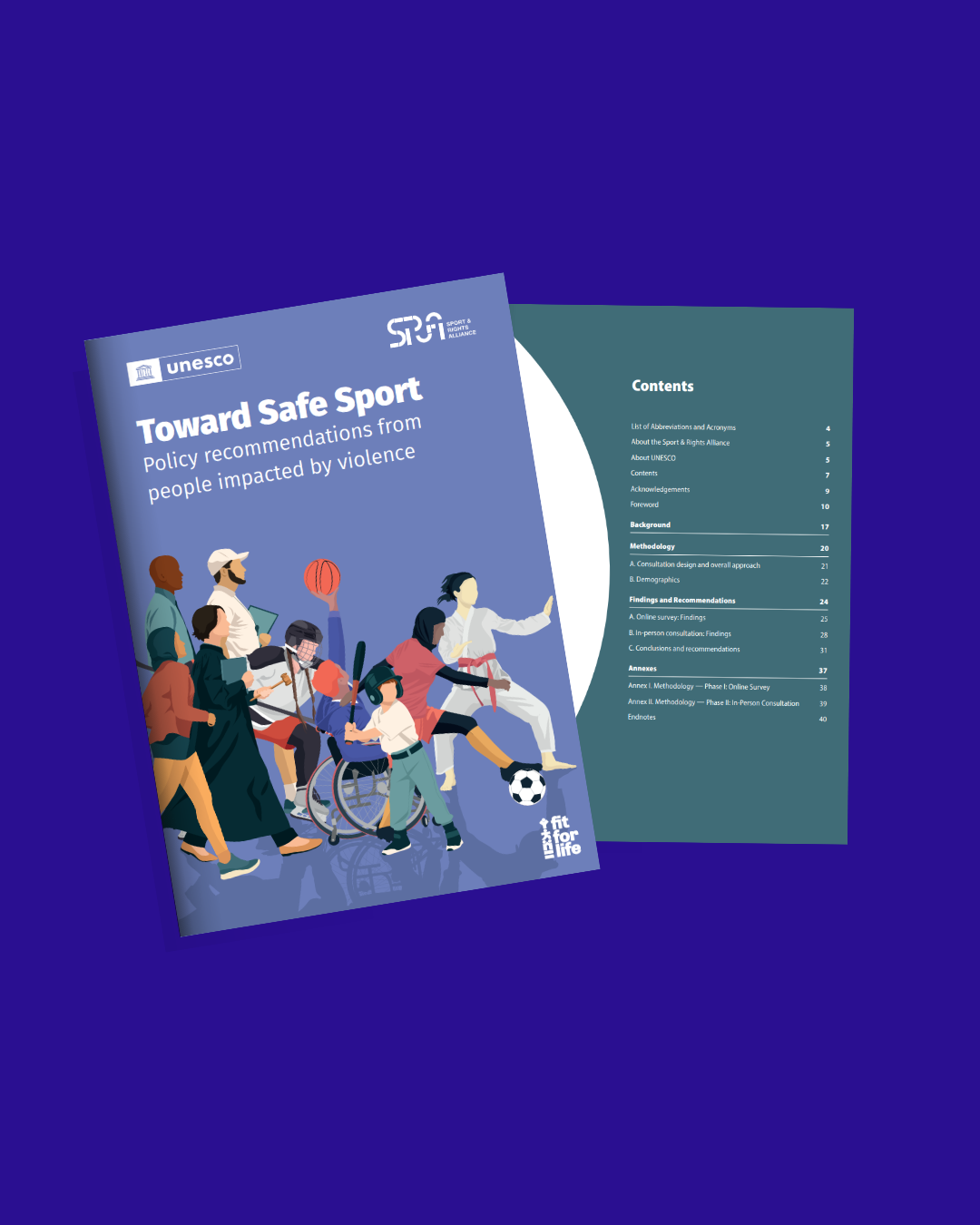
The session concluded with moderator Joanna Maranhao highlighting the importance of two key documents currently under development – the International Safe Sport Framework (ISSF) and the Global Policy Standards for Inclusive, Equitable and Safe Sport, led by the IOC and UNESCO respectively. She emphasized how these initiatives represent crucial opportunities for political commitment and effective action.