


Opinion Poll Conducted in 15 Countries Shows a Majority of the Public Agree
(Nyon, Switzerland, June 22, 2023) – A global coalition of human rights groups, trade unions, players and fans is urging FIFA to ensure that human rights are a primary consideration in choosing which countries can host the 2030 men’s football World Cup.
With the bidding process expected to begin soon, the Sport & Rights Alliance asks FIFA to ensure that the bid evaluation process reflects the results of an opinion poll commissioned by Amnesty International and conducted in 15 countries, which showed that a majority of the public, 53%, believe human rights should be a critical consideration in deciding who hosts major international sporting events.
Steve Cockburn, Amnesty International’s head of economic and social justice, said: “It is clear that the public wants human rights to be a high priority so that the World Cup is a celebration of the game they love and never provides a platform for exploitation, repression or discrimination.
“FIFA must rigorously apply the highest human rights standards in evaluating all bids to host its flagship tournament, demand clear human rights action plans, and reject any bid that fails to credibly show how serious human rights risks would be prevented, independently monitored, and remedied if abuses occur.”
FIFA introduced human rights criteria for the first time in the bidding for the 2026 World Cup, following controversies around the process to award the 2018 and 2022 tournaments to Russia and Qatar respectively. It is expected such criteria will be included again, but there are concerns that they may be sidelined or ignored in FIFA’s choice of the 2030 hosts.
Despite the introduction of its human rights policy and bidding criteria in 2017, FIFA has since failed to perform appropriate human rights risk assessments when awarding other tournaments. For example, since 2017, the Club World Cup has been granted to China, the United Arab Emirates, Morocco and Saudi Arabia without any transparent process or consultation with civil society. There were also widespread violations of human rights in relation to the 2022 World Cup in Qatar, despite FIFA having developed a “sustainability strategy”, which included human rights commitments, in 2020. Hundreds of thousands of migrant workers remain without compensation for abuses they suffered in preparing and delivering the tournament.
The call comes as Amnesty International published the results of an opinion poll conducted by YouGov, showing that a majority of people, 53%, in 15 countries believe that human rights, including workers’ rights, press freedom and non-discrimination, should be a key consideration when selecting the host of a major sporting event.
Joint bids to host the 2030 men’s World Cup are expected, including one from Spain, Portugal, Morocco and Ukraine, and another from Argentina, Chile, Paraguay and Uruguay. Saudi Arabia is reportedly preparing a joint bid either for 2030 or 2034, with Greece, and Egypt has been raised a possible partner.
The poll showed that, after safety and security (57%), human rights was the most commonly chosen consideration for determining tournament hosts (53%). This was the top consideration in seven of the countries surveyed, and highest in Switzerland (68%), where FIFA is based. More than four times as many people, or 53%, chose human rights as a key factor that should determine the hosts, versus 13% who selected ‘commercial revenues for sports bodies’ as a priority.
Ronan Evain, executive director of Football Supporters Europe, said: “The results of the poll clearly show the importance fans place on human rights in determining the hosts of major sports events – far more than politics or profit. We, football supporters, want binding guarantees not only that their own rights will be respected, but also that workers will be assured of decent conditions, journalists will be able to report freely, and human rights activists can speak out without fear.”
Andrea Florence, director of the Sport & Rights Alliance, said: “Since 2017, FIFA has made important progress in recognizing its human rights responsibilities. But human rights assessments and considerations have not been applied systematically when awarding FIFA tournaments. To demonstrate they are serious about their own policies and statutes, it is critical that FIFA puts human rights front and centre when choosing the host for the 2030 men’s World Cup.”
Background and Polling
The poll involved almost 17,500 adults in 15 countries. They were asked by YouGov last year to select from a list of ten factors they believed should be ‘key considerations’ when selecting the host of an international sporting event, such as the FIFA men’s World Cup or the Olympic Games. Those polled could select multiple options. The survey was carried out in Argentina, Belgium, Denmark, Finland, France, Germany, Kenya, Mexico, Morocco, Netherlands, Norway, Spain, Switzerland, UK and USA.
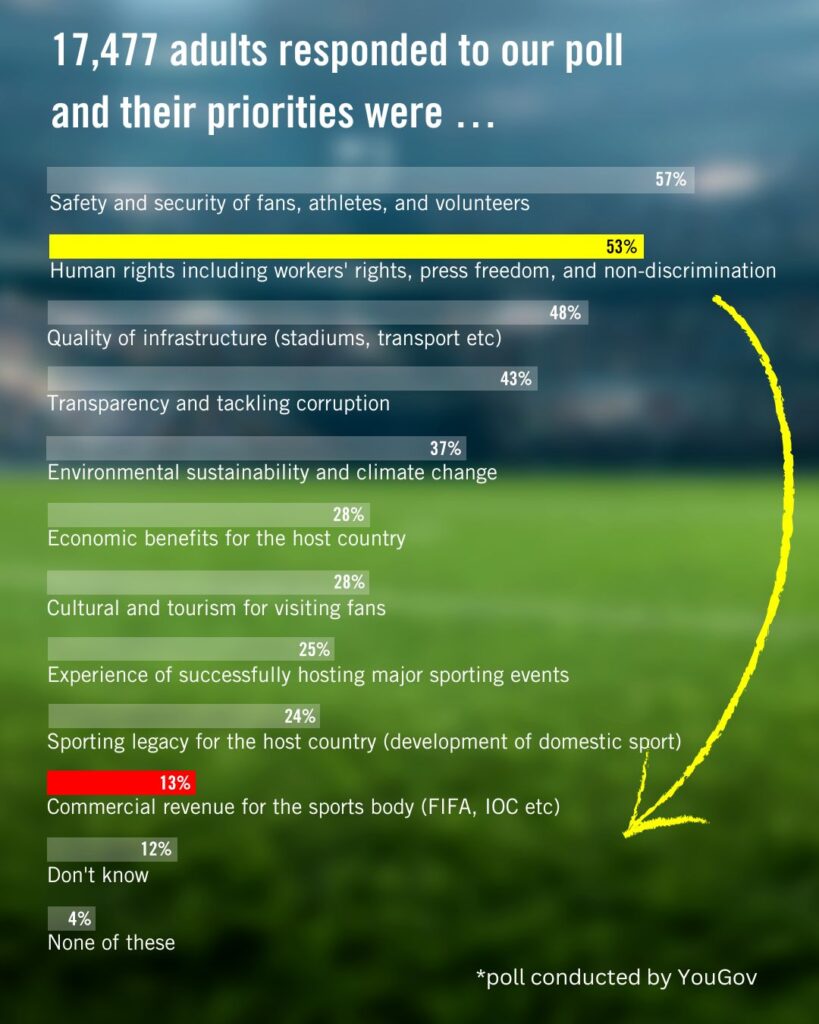
The results in order were: Safety and security of fans, athletes and volunteers (57%), Human rights including workers’ rights, press freedom and non-discrimination (53%), Quality of infrastructure such as stadiums, transport, and hotels (48%), Transparency and measures to tackle corruption (43%), Environmental sustainability and climate change (37%), Potential economic benefits for the host country (28%), Cultural and tourism opportunities for visiting fans (28%), Experience of successfully hosting major sporting events (25%), Sporting legacy for the host country such as the development of domestic sport (24%), Potential commercial revenue for the sports body such as FIFA or the International Olympic Committee (13%), Don’t know (12%), and None of these (4%).
FIFA’s Statutes (article 3) and Human Rights Policy (article 7 and 10) require the global football governing body to “respect” and “strive to promote” human rights, identify and address any adverse human rights impacts of its operations, and to constructively engage with relevant authorities and other stakeholders in its efforts to uphold these responsibilities.
In its Human Rights Policy, FIFA also commits to respecting human rights in line with the United Nations Guiding Principles on Business and Human Rights. According to the UN Guiding Principles, all companies should conduct human rights due diligence in relation to all aspects of its operations. If serious human rights risks cannot or will not be prevented, the company should take the necessary steps to cease or prevent its impact.
The final choice of host for the 2030 men’s World Cup is expected to be decided by a vote of all football associations at the annual FIFA Congress in 2024. In 2018, FIFA selected Canada, Mexico and the United States to jointly host the 2026 men’s World Cup.
Members of the Sport & Rights Alliance include Amnesty International, Committee to Protect Journalists, Football Supporters Europe, Human Rights Watch, International Lesbian, Gay, Bisexual, Trans and Intersex Association (ILGA World), International Trade Union Confederation (ITUC), The Army of Survivors, Transparency International and World Players Association.
All figures, unless otherwise stated, are from YouGov Plc. Total sample size was 17,477 adults. Fieldwork was undertaken between 16 August – 6 September 2022. The survey was carried out online. The figures have been weighted and are representative of all surveyed countries’ adults (aged 18+).