


Voices of impacted people on participation of athletes convicted of sexual offenses
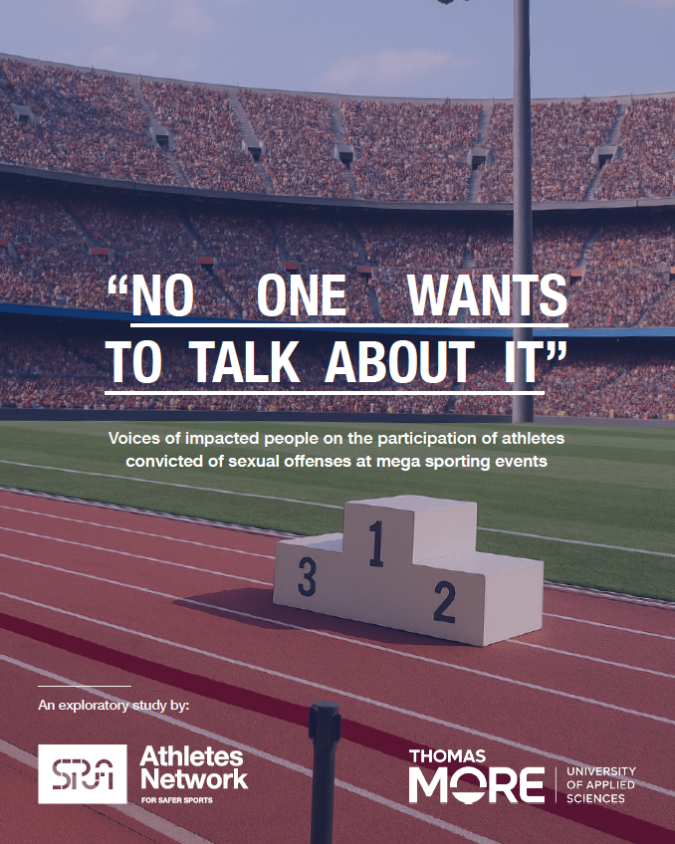
(Amsterdam, October 6, 2025) – The Sport & Rights Alliance’s Athletes Network for Safer Sports has released a crucial new exploratory study, “No one wants to talk about it:” Voices of impacted people on the participation of athletes convicted of sexual offenses at mega sporting events. In collaboration with Thomas More University of Applied Sciences, the report addresses the complex ethical dilemma surrounding the eligibility and accreditation of athletes with prior criminal sexual convictions at the highest levels of competition.
“When it comes to the question of whether to allow athletes convicted of sexual crimes to participate in mega sporting events, the impact on survivors should be a critical part of the discussion,” said Joanna Maranhão, network coordinator at the Sport & Rights Alliance. “Beyond the outstanding athletic performances we all cherish and support, what kind of culture do we want to showcase, and which values do we want to uphold? This is not a simple conversation, but no matter what, we must ensure the voices of those impacted are at the center. We are proud that the Athletes Network has taken a step in that direction.”
The study was developed as a follow-up to the statements in 2024 led by survivor-led organizations: the Athletes Network for Safer Sports, Kyniska Advocacy, and The Army of Survivors. Employing trauma-informed interviews with people impacted by abuse in sport, the report aims to elevate the voices of those most affected on a topic historically dominated by institutional discretion.
Key findings: A crisis of trust and prioritization
The report highlights a profound disconnect between the stated values of elite sport and institutional actions, revealing five key themes from the experiences shared by participants:
- Institutional distrust and inconsistency: Participants expressed a deep lack of trust in sport governing bodies, believing decisions are often swayed by financial interests and the status of the high-profile athlete. Findings from the desk research confirmed a lack of consistent global approach and clear, transparent eligibility standards regarding athletes with prior criminal sexual offenses.
- Eligibility is a privilege, not a right: The belief was strong and consistent: competing at mega sporting events is a privilege that must be earned and maintained through ethical conduct, not merely athletic performance. Participants called for shared standards of accountability that transcend national boundaries, asserting that ethical conduct is integral to legitimate participation.
- The harm of institutional inaction: The emotional toll of silence and inaction from institutions was central. The presence or public celebration of known offenders can re-traumatize victims, create unsafe environments, and signal that sexual violence is not taken seriously by the sport community.
- Centering the impacted: Participants overwhelmingly underscored the need for policies to meaningfully reflect the voices of survivors and those with lived experience. They argued that including survivors in decision-making and policy development is essential for structural change and to restore dignity.
Recommendations for a safer sports ecosystem
Based on the evidence and the perspectives of the impacted community, the report presents a number of urgent recommendations for global sport governing bodies:
- Establishment of a multidisciplinary working group: Form an international and multicultural working group – including people with lived experience, forensic psychologists, civil society organizations, and expert researchers – to review current eligibility criteria. This group should aim to balance the right to reintegration with the potential impact an athlete’s participation would have on the wider sports community.
- Broader, trauma-informed consultation: Sport governing bodies must adopt consultation processes that incorporates and center the voices of impacted people when developing eligibility policy, using a trauma-informed approach that prioritizes psychological safety.
- Background checks: As part of a larger safeguarding framework, criminal background checks should be a standardized and mandatory component of the eligibility screening process for mega sporting events – supported by clear guidelines for interpretation to avoid misuse against marginalized communities.
- Transparent and ongoing communication with wider sports community: In cases where a convicted athlete is allowed to participate, global sport governing bodies should communicate this decision transparently. This should include a clear explanation of the decision-making process and outline the measures put in place to protect all participants, particularly those at higher risk.
The report concludes that more dialogue, research, and deliberation are urgently needed to support safer environments at mega sporting events that prioritize safeguarding and acknowledge the needs of impacted people.
Click here to read the full report.
***
The Sport & Rights Alliance’s mission is to promote the rights and well-being of those most affected by human rights risks associated with the delivery of sport. Its partners include Amnesty International, The Army of Survivors, Football Supporters Europe, Human Rights Watch, ILGA World (The International Lesbian, Gay, Bisexual, Trans and Intersex Association), the International Trade Union Confederation, Reporters Without Borders, Transparency International, and World Players Association, UNI Global Union. As a global coalition of leading nongovernmental organizations and trade unions, the Sport & Rights Alliance works together to ensure sports bodies, governments, and other relevant stakeholders give rise to a world of sport that protects, respects, and fulfills international standards for human rights, labor rights, child wellbeing and safeguarding, and anti-corruption.