

Working Group on Women’s Category Lacks Transparency, Legitimacy
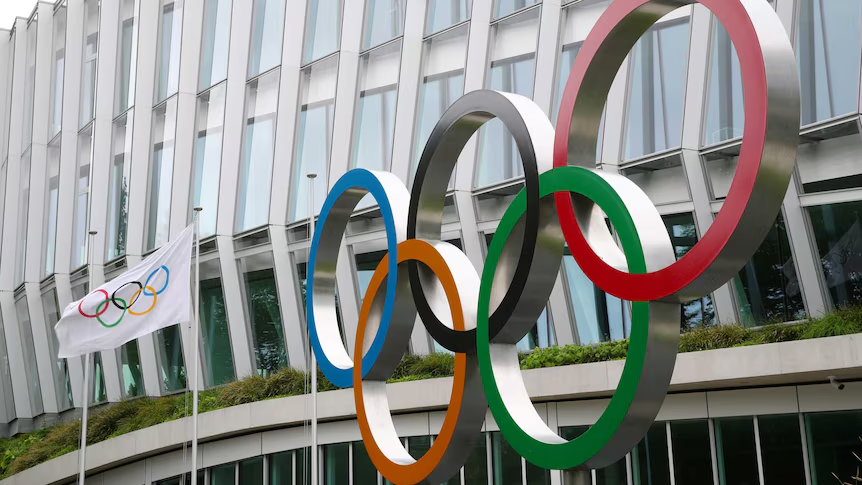
(Amsterdam, September 30, 2025) – The International Olympic Committee’s (IOC) decision to create a new working group on the “protection of the female category” without disclosing its members or process presents an alarming risk for all women athletes, the Sport & Rights Alliance said today.
This move, a departure from the transparency for three other new working groups, signals a dangerous retreat from the IOC’s human rights commitments, including its 2021 Framework on Fairness, Inclusion and Nondiscrimination on the Basis of Gender Identity and Sex Variations. It opens the way for restoring practices that have long threatened women’s rights and protection.
“This opaque process stands in stark contrast to the comprehensive, transparent, and multi-stakeholder consultation that led to the development of the IOC’s widely-respected Fairness Framework,” said Andrea Florence, executive director of the Sport & Rights Alliance. “A result of extensive research and engagement with athletes, human rights experts, medical professionals, and other impacted groups, this landmark document recognized the complexity of this issue and rejected a one-size-fits-all solution. The IOC appears to be setting aside this valuable body of research and policy in favor of a process that lacks the rigor and inclusivity of its predecessor.”
The Alliance acknowledges the sensitive nature of the topic, which is often a target for misinformation, disinformation, and hateful rhetoric. However, the creation of this working group seems to neglect human rights standards previously committed to by the IOC, undermining the legitimacy of the process and the trustworthiness of the policies it will recommend.
Clear communication and transparency are paramount to developing legitimate recommendations. Unlike for the other three working groups – on the Youth Olympics, the Olympic sports program, and commercial partnerships and marketing – the “female category” group’s membership and work plan has not been published, the IOC said, to “protect the integrity of the group and their work.”
“If the IOC truly wants to protect women and girls and promote fairness with an evidence-based approach, it must make room at the table for all perspectives, and ensure its processes are clear and public,” said Steve Cockburn, head of business and human rights for Amnesty International. “The greatest risk is not that the working group might receive public scrutiny, it is that women and girls all over the world – and especially from the Global South – might be subjected to further hate and discrimination and excluded from sport. This is a fundamental issue of safety and equality that cannot be decided in secret.”
The Alliance further expressed concern that exclusionary policies can cause a ripple effect that harms all women and girls in sport.
“The IOC’s Fairness Framework made significant gains to protect women and girls in sport,” said Minky Worden, director of global initiatives at Human Rights Watch. “The IOC set an important precedent in moving away from surveillance, invasion of privacy, and harmful sex-testing practices that caused decades of trauma and discrimination. It is disappointing to see the leader of global sport now potentially creating a pathway for their return.”
The IOC should work with civil society to create a transparent process to form this working group to ensure its legitimacy and diversity in both membership and approach, the Alliance said. The IOC should confirm its mandate is to build upon the principles of its previous inclusive, evidence-based framework. Meaningful consultation with all affected athletes should not be optional; it is essential and necessary for a legitimate process.
“The IOC and this working group should commit to a process that is transparent, inclusive, and grounded in human rights principles,” said Joanna Maranhão, network coordinator at the Sport & Rights Alliance. “The working group’s mandate should be to build upon the 2021 Framework, not to discard it. The future of fair and inclusive sport depends on an open and honest dialogue with all stakeholders – and with impacted athletes at the heart of the process.”