

In 2013, then-FIFA secretary general Jérôme Valcke gave a press conference in which he clarified FIFA’s strategy for choosing World Cup hosts: “I will say something which is crazy, but less democracy is sometimes better for organizing a World Cup. …When you have a very strong head of state who can decide, as maybe Putin can do in 2018…that is easier for us organizers.”
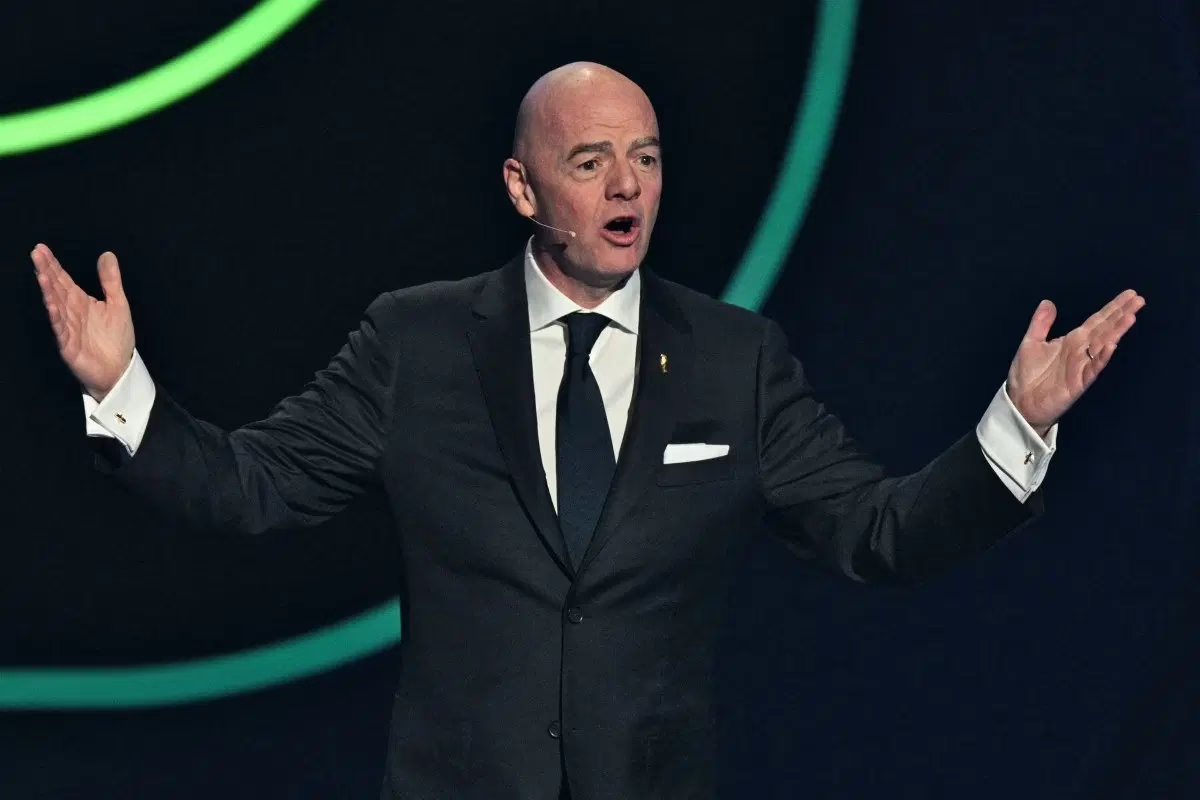
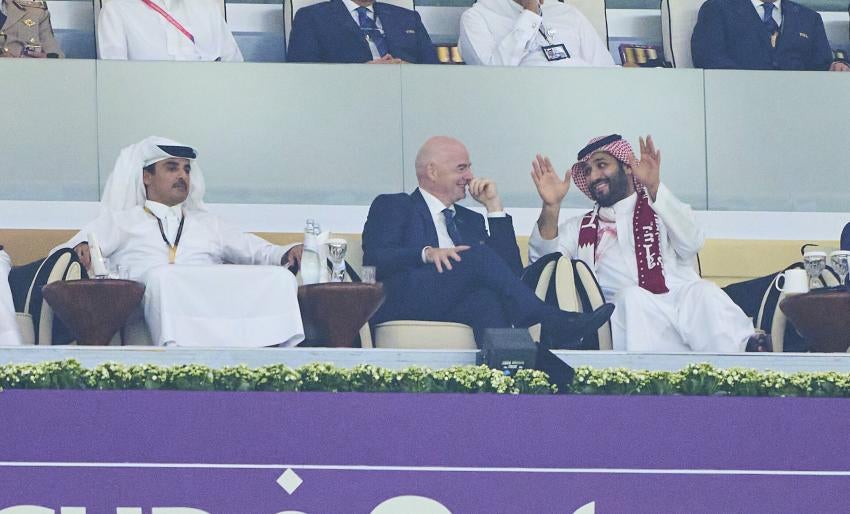
Mr. Valcke was later convicted in Switzerland of corruption, but the global soccer governing body’s apparent preference for working with autocrats remains and was on full display this week, when the backing of FIFA president Gianni Infantino effectively delivered the 2034 Men’s World Cup to Saudi Arabia.
On October 31, Saudi Arabia became the “sole bidder” to host the 2034 World Cup, when Australia, the only country with a potential competing bid, dropped out. FIFA will still certify the World Cup award at meeting next year, but there is no doubt about the outcome with only one candidate.
This ultimate soccer tournament will be the brightest jewel yet in Saudi Arabia’s “sportswashing” crown. The oil-rich kingdom has been determined to buy the halo effect of hosting sport’s largest and most popular event, hoping this will wash away its poor human rights reputation. Saudi Arabia is the world champion sportswasher, paying top dollar for the rights to host mega-sporting events and acquiring entire teams and leagues to buy the benefits of being associated with popular sports, including Formula 1 racing and the PGA golf tour.
Despite FIFA pledging to uphold human rights and labor standards in selecting hosts, it is set to award the 2034 games with no human rights due diligence—none is possible due to Saudi government repression. FIFA is also failing to learn the lessons of recent history that granting its largest event without human rights protections can be catastrophic for the workers who build and service the tournament.
When governments without the rule of law, press freedom or protections for workers host these events—as with Russia’s 2018 World Cup and China’s 2008 Summer Olympics—the result has been serious human rights abuses, such as arrests of journalists, discrimination against LGBT athletes and fans, and deaths of thousands of migrant workers.
When FIFA named Qatar the World Cup host in 2010, it was without human rights due diligence on the dangerous conditions for millions of migrant workers who were needed to build stadiums and hotels, working under the kafala sponsorship system.
In 2022, Qatar became the most lucrative World Cup ever for FIFA—but also the deadliest. Official Qatari statistics show that 15,021 non-Qataris died in the country between 2010 and 2019, when the main infrastructure for the FIFA World Cup was built. Human Rights Watch documented how migrant workers who built $220 billion worth of FIFA infrastructure for the 2022 World Cup faced widespread abuses including extreme heat and humidity, wage theft and exorbitant recruitment fees. “At work [in Qatar], we had to pour out sweat from our shoes,” a former construction worker said.
Saudi Arabia has a similar climate—but more than six times the number of migrant workers. FIFA’s bidding documents say 14 stadiums are needed to host the 48-team tournament, and an estimated 13.4 million migrant workers labor in construction or other low-wage service sector jobs with few human rights protections.
Saudi Arabia bars labor unions, strikes and protests.
Saudi Arabia’s human rights record includes the imprisonment of scores of activists and dissidents for their peaceful criticism, repression of civil society, as well as oppression of women’s rights under its male guardianship system, and the killing of hundreds of migrants at the Saudi-Yemen border that may amount to crimes against humanity. Saudi courts have imposed decades-long sentences on Saudi citizens for tweets.
Sex outside marriage and same-sex relations are crimes, with punishments including the death penalty.
Saudi Arabia has no independent media freedom, a basic requirement for World Cup hosts. Five years ago, Saudi agents murdered and dismembered Washington Post columnist Jamal Khashoggi, who had been critical of the Saudi government.
Human rights reforms were adopted in FIFA only after a massive corruption scandal over selling votes for the last two World Cups toppled former president Sepp Blatter in 2015.
In 2016, FIFA embraced the United Nations Guiding Principles on Business and Human Rights and hired human rights staff. In 2017, FIFA published a new Human Rights Policy promising protections across its global operations. FIFA set up important new human rights bid requirements for the 2026 World Cup in the U.S., Mexico, and Canada, claiming “human rights commitments are binding on all FIFA bodies and officials.
But FIFA ignored its human rights standards for the World Cups it granted to Russia, Qatar and now, effectively, Saudi Arabia. Human Rights Watch contacted FIFA in February and October to request details on human rights due diligence and stakeholder consultation ahead of awarding Saudi Arabia the Asian Cup and the Club World Cup tournaments. FIFA has not responded.
FIFA’s human rights rules require bidders for the World Cup to “engage with human rights stakeholders” and allow independent human rights monitoring within the country. This requirement alone should have raised serious concerns about Saudi Arabia being considered to host the World Cup.
Many of the country’s courageous human rights defenders are in prison or in exile, unavailable to help meet this requirement, making it clear that FIFA never meant to abide by its pledges.