

New report highlights how lived experience can help governments build safer, more accountable and more effective sport systems
17 June 2026 — Violence in sport is increasingly recognized as a global challenge. Yet many of the people most affected by abuse, violence and unsafe sporting environments remain largely absent from the policy discussions intended to protect them.
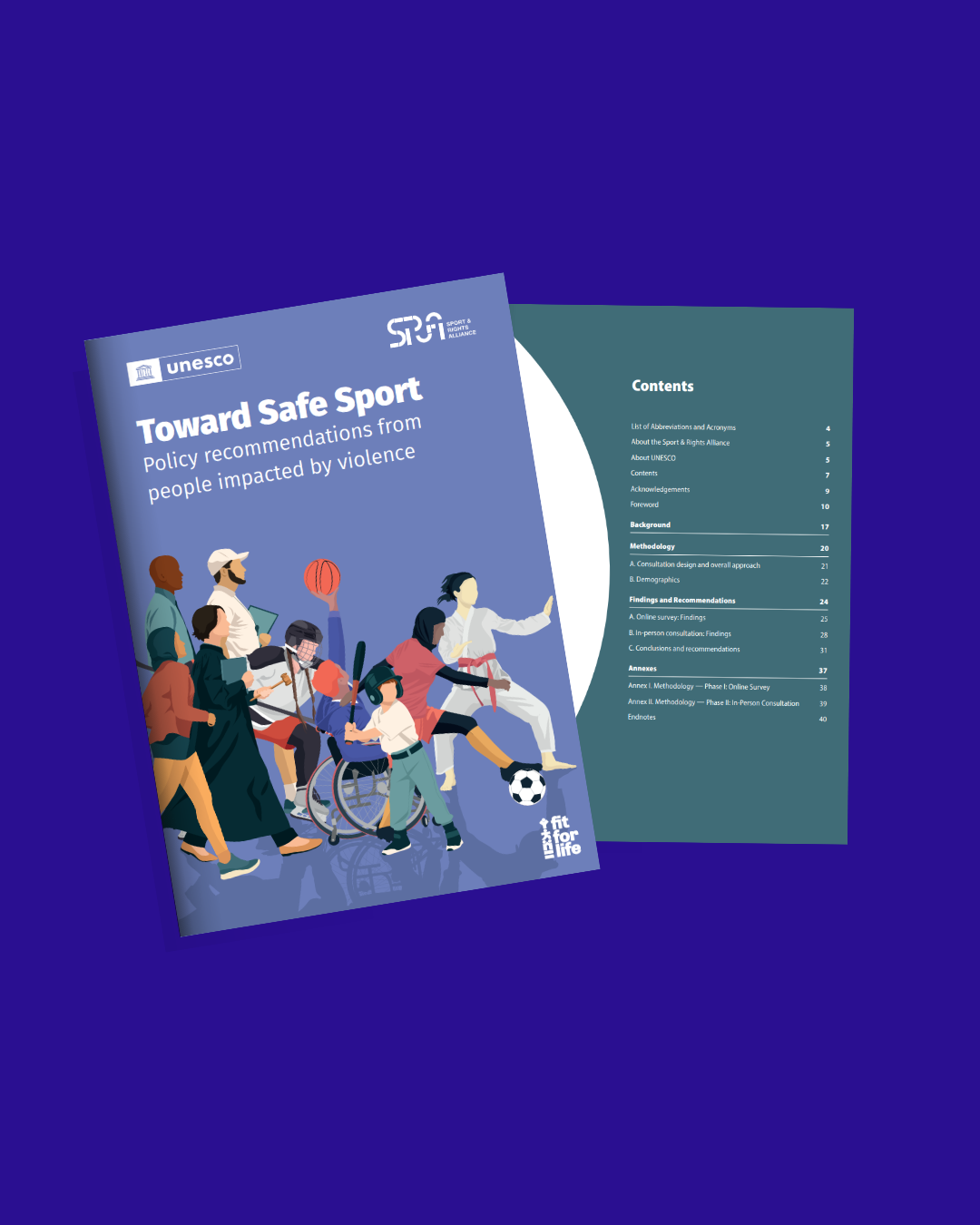
On 15 June 2026, during the Ordinary Session of UNESCO’s Intergovernmental Committee for Physical Education and Sport (CIGEPS), UNESCO and the Sport & Rights Alliance (SRA) launched a new report, Toward Safe Sport: Policy Recommendations from People Impacted by Violence in Sport.
The publication presents findings and recommendations emerging from a two-phase consultation process involving survivors, whistleblowers, advocates, bystanders and others impacted by violence in sport. The report forms part of UNESCO’s broader efforts to advance Safe Sport through its Fit for Life Sport Alliance and the development of the Global Policy Standards for Inclusive, Equitable and Safe Sport and Physical Education.
Safe Sport as a growing global policy priority
At the 7th International Conference of Ministers and Senior Officials Responsible for Physical Education and Sport (MINEPS VII), ministers and senior officials from more than 110 countries identified safety as a shared priority for sport and physical education systems. Since then, UNESCO has engaged governments, athletes, researchers, sport organizations, civil society actors and UN entities through a continuum of consultations, policy dialogues and global events.
These efforts have highlighted a common challenge: while awareness of safeguarding issues has increased, responses remain fragmented and inconsistent across countries and sport systems.
According to World Players Association, 21% of female athletes and 11% of male athletes experienced one form of sexual abuse as least once as a child in sport. Women and girls, persons with disabilities and other groups often face heightened and intersecting risks. Yet many countries still lack common definitions, comparable data and coordinated systems for prevention, reporting, response, protection and accountability.
Preliminary findings from UNESCO’s first Global Sport Policy Survey reinforce this picture. While 77% of responding countries report providing safeguarding training programmes, only 18% report having systems to collect, analyse and report criminal or judicial data relating to cases of violence in sport.
UNESCO
Centring lived experience in policy development
To help address these gaps, UNESCO established a Global Safe Sport Taskforce bringing together Safe Sport experts and practitioners as the principal technical advisory mechanism to reinforce the Safe Sport dimensions of the forthcoming Global Policy Standards.
But UNESCO also recognized that technical expertise alone could not fully capture how safeguarding systems are experienced in practice.
This dedicated consultation process with people impacted by violence in sport was therefore designed to ensure that those who are most affected could meaningfully contribute to the development of policy solutions.
Phase I consisted of an online survey involving 138 participants from 24 countries and 17 sports. Phase II brought together 10 participants with lived experience from 8 countries and 7 sports for an in-person focus discussion at UNESCO Headquarters in Paris.
Participants consistently emphasized that survivors should not be viewed simply as witnesses to harm, but as knowledgeable partners capable of identifying barriers and improving policy implementation.
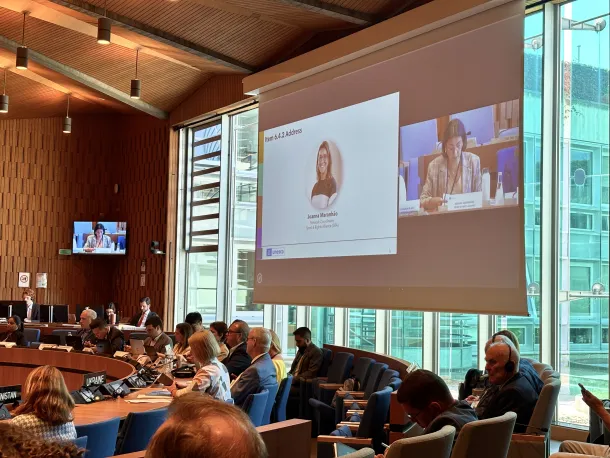
When we emphasize the importance of centering lived experience, what we are really saying is that, together with other forms of expertise, survivors and whistleblowers can provide critical insights into where systems fail, why individuals fear reporting, what kind of support is missing, and why accountability is essential to build trust.
— Joanna Maranhão, Network Coordinator, Sport & Rights Alliance and Co-Chair of UNESCO’s Global Safe Sport Taskforce
What participants told us
The consultation found strong support for UNESCO’s draft Global Policy Standards.
90% percent of participants considered the Standards useful, 80% believed they could help harmonize approaches across countries and organizations, and 76% felt they could strengthen impact.
At the same time, participants identified several priorities for further development.
Among the strongest recommendations were the need for:
- clearer definitions of safeguarding, Safe Sport and violence;
- stronger implementation guidance;
- independent oversight and accountability mechanisms;
- transparent reporting and case-management systems;
- protections for whistleblowers and reporting persons;
- survivor-centred and trauma-informed approaches;
The consultation also reinforced the importance of ensuring that participation itself is grounded in trust, dignity and respect. Participants rated both the consultation process and the value of engagement extremely highly, with average scores of 4.8 and 4.9 out of 5 respectively.
UNESCO
From policy commitments to implementation
The findings have already informed revisions to UNESCO’s Global Policy Standards, particularly Standard 10 on Safe Sport and Safe Delivery.
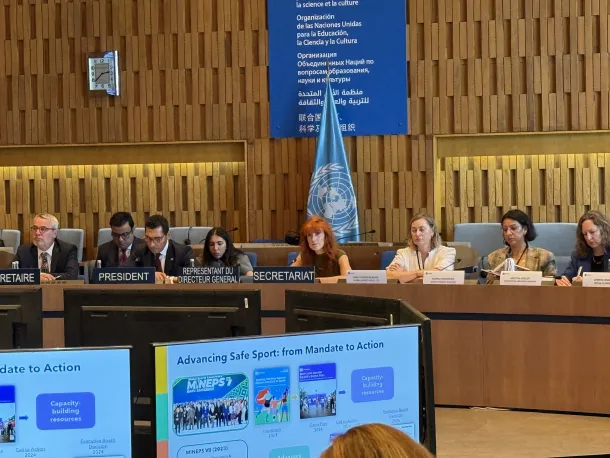
Speaking during the CIGEPS session, Emily Cameron-Blake, Director of Global Sports Policy Ltd and member of UNESCO’s Global Safe Sport Taskforce, highlighted that the existence of policies alone does not guarantee safer sport environments.
“We have countries with detailed codes and no independent case management. Countries with reporting hotlines that route back to the very federation being reported against. Countries with mandated screening procedures that are applied inconsistently or not at all.”
— Emily Cameron-Blake, Director, Global Sports Policy Ltd and Member of UNESCO’s Global Safe Sport Taskforce
She emphasized that monitoring, evaluation, data collection and accountability mechanisms are essential if governments are to understand whether policies are actually working in practice.
Looking ahead
The report represents both an outcome and a starting point.
Its findings will continue to inform the development of UNESCO’s Global Policy Standards and future implementation tools. UNESCO will also continue working with Member States and partners to strengthen the evidence base for Safe Sport, support policy implementation and explore how lived experience can continue to inform future work.
As governments prepare for the next phase of consultation on the Global Policy Standards and the lead-up to MINEPS VIII, the report provides a practical resource for policymakers, sport organizations, safeguarding practitioners and civil society organizations seeking to strengthen protection, accountability and trust across sport systems.
We hope this publication contributes to a broader conversation about how sport systems can become safer, more inclusive and more accountable for everyone who participates in them.
— Nancy McLennan, Fit for Life Lead, UNESCO